Carry On Luggage: The Complete UK Guide to Cabin Bags, Sizes and Packing
Every year, thousands of passengers arrive at the gate to find their bag is a centimetre too wide, and face a last-minute hold-baggage fee that costs more than the bag itself. A carry on is the piece of luggage you take into the aircraft cabin with you, and getting it right from the start will save you money, stress and time at the airport.
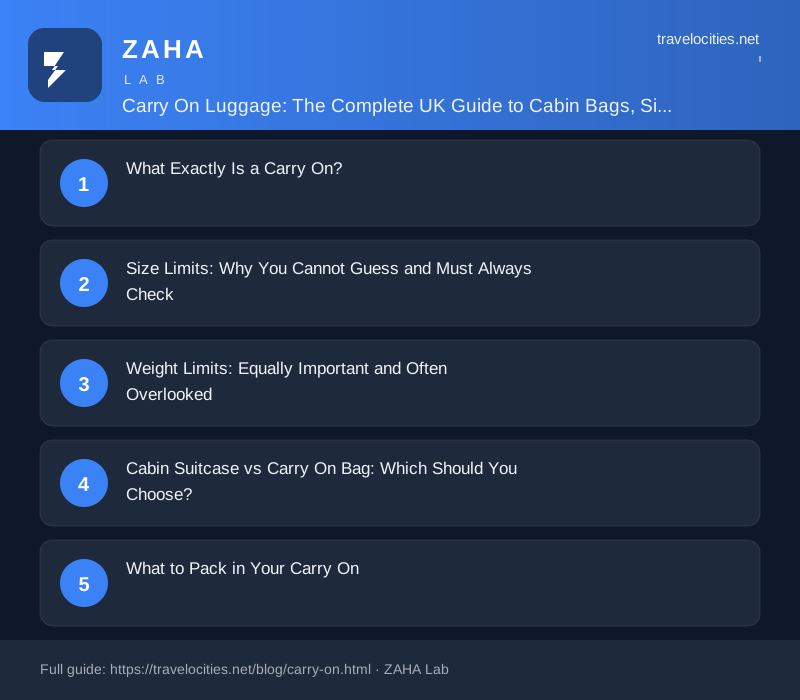
What Exactly Is a Carry On?
A carry on, also called a cabin bag or cabin suitcase, is any piece of luggage small enough to be taken into the aircraft cabin rather than checked into the hold. You keep it with you throughout the flight, stowing it in the overhead locker or under the seat in front of you.
The term covers a range of bag types: a compact hard-shell cabin suitcase with wheels, a soft-sided carry on bag with a top handle and shoulder strap, or a structured backpack designed to meet airline dimensions. All of these can qualify as a carry on, what matters is whether the airline accepts the size and weight, not the style of bag.
Travelling with just a carry on (sometimes called "hand luggage only") means you skip the check-in queue, avoid hold-baggage fees, and walk off the plane straight to the exit. For trips of a week or less, many people manage comfortably with a single carry on bag.
Size Limits: Why You Cannot Guess and Must Always Check
This is the section most people skim, and then regret. Carry on size limits vary significantly between airlines, and even between fare types on the same airline. There is no universal standard, and the differences are not trivial.
As a rough guide, most European airlines allow a maximum cabin bag in the region of 55 x 40 x 20 cm, but some budget carriers set noticeably tighter limits, and some full-service carriers are more generous. Crucially, several airlines now have a tiered system where only passengers on higher fare types or with certain membership levels can use the overhead locker freely; passengers on the cheapest fare may only be permitted a small personal item under the seat.
The only reliable way to know your limit is to check the specific airline's baggage policy for your booking, look under the heading for your fare class or ticket type. Do this at the time of booking, not the morning of departure. Policies do change, so re-check a few days before travel if you booked far in advance.
When checking dimensions, note whether the airline measures the bag with or without wheels and handles. Some quote the "overall" size including those protrusions. If your bag is close to the limit, consider this carefully, a bag that is exactly 55 cm in the measurements may tip over when wheels are added.
Weight Limits: Equally Important and Often Overlooked
Plenty of travellers buy a cabin suitcase that meets the size rules, fill it carefully, and then get flagged at the gate because it is overweight. Weight allowances for carry on luggage vary just as much as size limits. Some airlines set no weight limit at all for cabin bags; others cap them at a figure that can feel surprisingly restrictive once you factor in the weight of the bag itself.
A hard-shell cabin suitcase tends to weigh more empty than a soft carry on bag of the same capacity. If you are on an airline with a tight weight limit, a lighter soft-sided bag gives you more of that allowance for your actual belongings.
Weigh your packed bag at home on bathroom scales before you leave. If you are at or near the limit, remove something rather than risk a fee at the airport. Gate staff do weigh bags, particularly on budget routes during busy periods.
Cabin Suitcase vs Carry On Bag: Which Should You Choose?
Both types can work brilliantly, the right choice depends on your trip, your travel style, and the airline you are flying with.
A cabin suitcase (a small wheeled case with a hard or semi-hard shell) offers structure and protection, making it easier to pack neatly and harder to overload. The rigid walls mean your contents are well protected, and most have combination locks. The trade-off is that they are heavier when empty and less flexible in shape, if the overhead locker is already partly full, a hard case cannot be squeezed or compressed the way a soft bag can.
A soft carry on bag, whether a holdall-style or a structured duffel, is typically lighter empty and can flex to fit into awkward spaces. Many have multiple external pockets that make organisation easier. The downside is that soft bags offer less protection for fragile items and can be tempting to overstuff, which leads to weight problems.
A few questions to guide your choice:
- How long is the trip? For longer trips where you need more clothing, a cabin suitcase's structured packing may help you use the space more efficiently.
- What is the airline's weight limit? If it is strict, lean towards the lightest bag you can find in the right size.
- Do you need to carry fragile items? A hard-shell cabin suitcase offers better protection.
- Will you be moving between accommodation frequently? Wheels are a real advantage on smooth airport floors but less so on cobbled streets or uneven terrain.
- Do you need a second personal item? Many airlines allow one cabin bag plus one small personal item (a handbag or laptop bag). If yours does, a compact carry on bag paired with a small backpack can be very practical.
What to Pack in Your Carry On
Because your carry on stays with you throughout the journey, it should contain everything you would be genuinely inconvenienced to lose, not just valuables, but essentials for the flight itself and the first day or two at your destination.
Things that should always travel in your carry on rather than checked luggage:
- Travel documents: passport, boarding passes, insurance documents, booking confirmations
- Medication, especially any prescription medication you need regularly or urgently
- Electronics: laptop, tablet, phone and their chargers
- Valuables: jewellery, cash, cards
- A change of clothes or at minimum a fresh top and clean underwear (useful if checked bags are delayed)
- Any irreplaceable items, such as a camera with photos not backed up
- Anything you need during the flight: headphones, reading material, a small travel pillow
If you are travelling with just a carry on and no hold luggage at all, think about what you genuinely need versus what you instinctively reach for. Most travellers are surprised by how little they actually use on a week's holiday compared with what they pack.
Liquids, Gels and Restrictions: What the Rules Actually Say
Liquids, gels, pastes, creams and aerosols in carry on luggage are subject to restrictions at UK airports and most international airports. The rules have been in transition in recent years, with some UK airports trialling updated technology that allows larger liquid volumes through upgraded security lanes. However, the rules are not uniform across all airports or all lanes, and they can change.
The safest approach before any trip is to check the current guidance directly with the relevant airport, as well as your destination country's entry requirements. Do not rely on what applied last time you flew, even if that was recently.
As a general principle that is unlikely to change regardless of updates: any liquids you do carry should be in secure, leak-proof containers, packed accessibly so you can remove them quickly at security. Any items you are uncertain about, particularly if they are expensive, like a perfume or skincare product, are worth placing in hold luggage if you have it, to avoid them being confiscated.
Sharp items such as scissors above a certain blade length, razor blades, and most tools are not permitted in cabin luggage at all. If in doubt, check the current prohibited items list published by the airport or the Civil Aviation Authority.
How to Pack a Carry On Efficiently
Fitting a week's worth of belongings into a small cabin bag is a skill, but it is genuinely learnable. A few techniques that make a real difference:
- Roll, don't fold. Rolling clothes tightly reduces creases and uses space more efficiently than folding flat, particularly for casual tops, t-shirts and trousers.
- Wear your bulkiest items. Trainers, jeans, and a thick jumper or jacket take up an enormous amount of bag space. Wear these on travel day rather than packing them.
- Use packing cubes. These fabric organisers compress clothing and keep your bag tidy so you are not unpacking everything to find one item.
- Decant toiletries into travel-sized containers. Full-size bottles and tubes are heavy and take up space. Small refillable containers of what you actually need save both weight and room.
- Lay everything out before you pack. Once you can see the full pile, it is much easier to make honest decisions about what stays and what gets left behind.
- Fill every void. Socks rolled into shoes, charging cables tucked into the corners, every gap is usable space.
If you are packing for the first time in a while, do a test pack a day or two before departure. Weigh the bag. Then leave it overnight and review with fresh eyes, you will almost certainly spot two or three things you can remove.
At the Airport: What to Expect
Having the right bag packed correctly is most of the work. A few things to know for the day itself:
At security, you will need to remove your bag from any outer carriers and place it on the conveyor. Laptops and large tablets usually need to come out and go in a separate tray. Keep this in mind when you pack, if the laptop is buried at the bottom, security becomes slow and stressful.
At the gate, staff may measure or weigh carry on bags, particularly on budget carriers. If your bag is clearly oversized or the flight is very full, you may be asked to check it into the hold. On some airlines this is free at the gate; on others it incurs a charge that is often higher than what you would have paid when booking. If there is any doubt about your bag's compliance, it is worth checking rather than hoping for the best.
On busy flights, overhead locker space fills quickly. Boarding as early as you can, whether by paying for priority boarding or simply being near the front of the group, increases the chance your bag goes in the locker above your seat rather than several rows away.
Frequently Asked Questions
What is the standard carry on size for UK flights?
There is no single standard, each airline sets its own dimensions, and these vary meaningfully between carriers. Most allow something roughly in the range of 55 x 40 x 20 cm, but budget airlines in particular may enforce tighter limits, and the rules can differ between fare classes on the same airline. Always check the specific baggage policy for your booking before you purchase a bag or before you pack.
Can I take a carry on bag and a handbag or laptop bag?
Many airlines do allow one cabin bag plus one smaller personal item, typically defined as something that fits under the seat in front. However, this is not universal: some carriers only allow a single item in the cabin on lower fare types, and others count a laptop bag or handbag as your full carry on allowance. Check the policy for your specific fare type, not just the airline in general.
Is a carry on bag enough for a two-week holiday?
It depends heavily on your destination, your plans, and how you pack. Many experienced travellers manage two weeks with a cabin bag using careful packing and, where available, laundry facilities. The key adjustments are wearing your bulkiest items on travel day, packing versatile clothing that mixes and matches, and being disciplined about toiletries. It is harder in winter when clothing is bulkier, and more straightforward for a warm-weather beach trip where lighter fabrics are the norm.
Affiliate disclosure: some links on this page are affiliate links. If you buy or book through one we earn a commission, at no extra cost to you. It never changes what we recommend.
What we would pack
These are the categories worth getting right for this trip. Choosing well here saves hassle at the airport far more reliably than spending more.
Booking the trip
When you are ready to book, these are the services we use: